Техническая документация
Характеристики
Brand
STMicroelectronicsТип продукции
LED Driver Evaluation Kit
Светодиодная технология
Светодиодный драйвер
Классификация комплектов
Демонстрационная плата
Для использования с
LED Driver
Представленное устройство
STP4CMP
Наименование комплекта
STEVAL
Стандарты/одобрения
RoHS
Страна происхождения
Italy
Информация о товаре
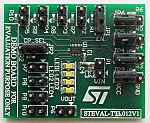
The STEVAL-TLL012V1 demonstration board demonstrates the performance of the STP4CMP, a charge pump based 4-channel LED driver designed for RGB illumination or LCD display backlighting. This device works off a battery with an input voltage between 2.7 V - 5.5 V. The device generates regulated current sinks with high absolute and channel-to-channel accuracy to drive up to 4 LEDs.
It can support LEDs with forward voltage as high as 3.8 V.
The current sink for each channel can be set with 4 individual external resistors. Each channel is controlled independently.
The PWM control can be applied directly to the 4 EN (enable) inputs to provide brightness control.
Информация о наличии не успела загрузиться
P.O.A.
1
P.O.A.
Информация о наличии не успела загрузиться
1
Техническая документация
Характеристики
Brand
STMicroelectronicsТип продукции
LED Driver Evaluation Kit
Светодиодная технология
Светодиодный драйвер
Классификация комплектов
Демонстрационная плата
Для использования с
LED Driver
Представленное устройство
STP4CMP
Наименование комплекта
STEVAL
Стандарты/одобрения
RoHS
Страна происхождения
Italy
Информация о товаре
The STEVAL-TLL012V1 demonstration board demonstrates the performance of the STP4CMP, a charge pump based 4-channel LED driver designed for RGB illumination or LCD display backlighting. This device works off a battery with an input voltage between 2.7 V - 5.5 V. The device generates regulated current sinks with high absolute and channel-to-channel accuracy to drive up to 4 LEDs.
It can support LEDs with forward voltage as high as 3.8 V.
The current sink for each channel can be set with 4 individual external resistors. Each channel is controlled independently.
The PWM control can be applied directly to the 4 EN (enable) inputs to provide brightness control.